Facebook Pixel

Professional Diploma in Cyber Security

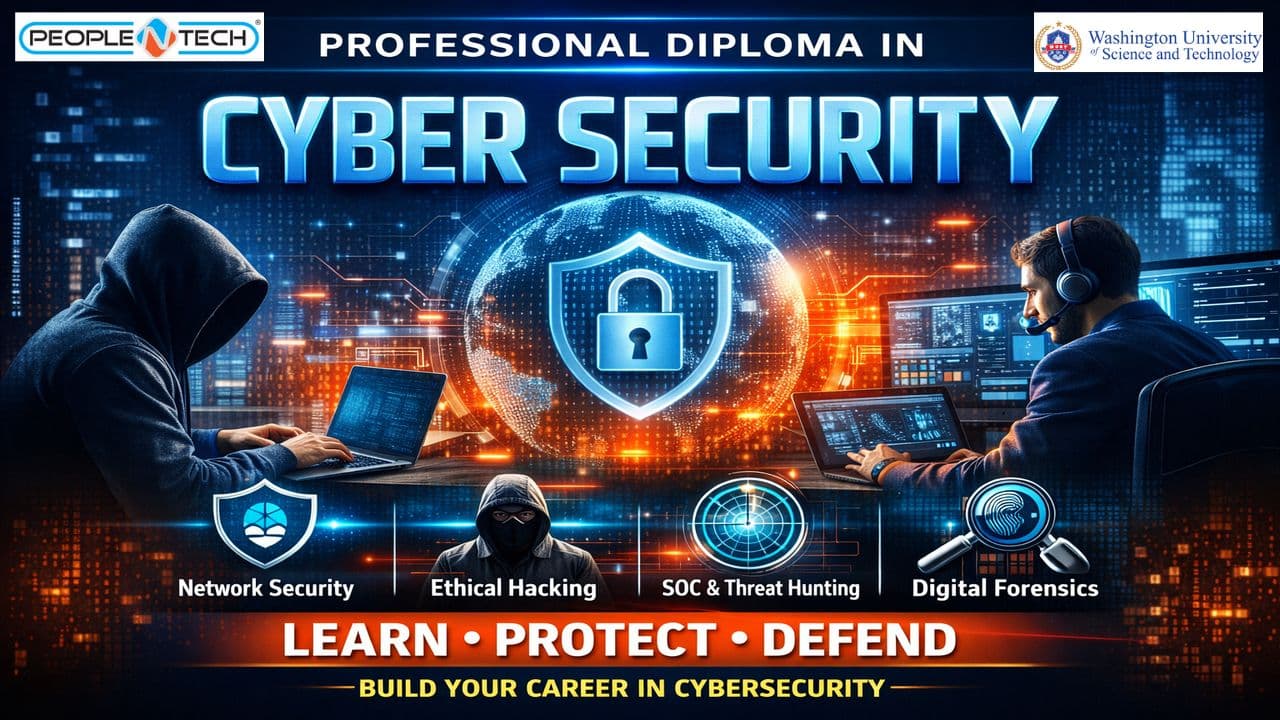
The Professional Diploma in Cyber Security is a comprehensive, hands-on program designed to develop practical skills in network security, ethical hacking, SOC operations, threat hunting, and digital forensics. The course prepares learners to protect modern IT infrastructures from cyber threats and pursue careers in the fast-growing cybersecurity industry.

Class - 80
Duration - 6 Months
Projects - 4
Joined - 37
Professional Diploma in Cyber Security

3000040000

3000040000

Details About the course

The Professional Diploma in Cyber Security is an industry-oriented training program that provides in-depth knowledge and practical expertise required to secure digital systems, networks, and data against evolving cyber threats. This course is structured to cover both defensive and offensive security techniques, ensuring learners gain a well-rounded understanding of cybersecurity operations.

The program begins with Network Fundamentals and Network Security Architecture, where students learn how modern networks operate and how to secure them using firewalls, access control lists (ACLs), intrusion prevention systems (IPS), VPNs, and cryptographic technologies. This module builds a strong foundation in securing enterprise-level network infrastructures.

The Ethical Hacking & VAPT (Vulnerability Assessment and Penetration Testing) module focuses on identifying, analyzing, and exploiting security vulnerabilities in systems, networks, web applications, mobile applications, APIs, and wireless environments. Students gain extensive hands-on experience with industry-standard tools and frameworks, learning how attackers think and how to defend against real-world cyberattacks. This module also emphasizes professional reporting and compliance with security standards.

The Cyber Security Operations Center (SOC) Management and Threat Hunting module prepares learners to work in real-time security environments. Students learn how to monitor security events, analyze logs, detect incidents using SIEM tools, manage incident response, and proactively hunt for advanced threats. This module is ideal for understanding how organizations defend against continuous cyber threats on a daily basis.

The course concludes with Digital Forensic Investigation, where learners gain knowledge of forensic principles, evidence handling, data acquisition, analysis, and reporting. This module equips students with the skills required to investigate cybercrimes, insider threats, malware incidents, and legal digital investigations while maintaining evidence integrity.

Throughout the program, students are assessed through written exams, practical labs, assignments, and class performance, ensuring both theoretical understanding and real-world competency.


Career Opportunities

After completing the Professional Diploma in Cyber Security, learners can pursue a wide range of high-demand roles, including:

  • Cyber Security Analyst

  • SOC Analyst (Level 1, 2, or 3)

  • Ethical Hacker / Penetration Tester

  • Vulnerability Assessment Specialist

  • Network Security Engineer

  • Incident Response Analyst

  • Threat Hunter

  • Digital Forensic Analyst

  • Information Security Officer

  • Cyber Security Consultant

This diploma also serves as a strong foundation for internationally recognized certifications such as CompTIA Security+, CEH, CHFI, GIAC, Cisco Security, and SOC-related certifications, significantly improving employability in both local and global job markets.

With cyber threats increasing worldwide, professionals trained in cybersecurity are in high demand across industries such as banking, telecommunications, healthcare, government, software companies, and multinational enterprises. This course opens pathways to stable, well-paying, and future-proof careers in the cybersecurity domain.

Course Modules

Module-1 : Network Fundamentals & Network Security Architecture
Class - 15
Quiz - 1
Assignment - 2
  • Implement AAA on Cisco routers using local router database and external ACS
  • Explain the functions and importance of AAA
  • Describe the features of TACACS+ and RADIUS AAA protocols
  • Configure AAA authentication
  • Configure AAA authorization
  • Configure AAA accounting
  • Mitigate threats to Cisco routers and networks using ACLs
  • Explain the functionality of standard, extended, and named IP Access Control List used by routers to filter packets
  • Configure and verify IP ACLs to mitigate given threats (filter IP traffic destined for Telnet, SNMP, and DDoS attacks) in a network using CLI
  • Configure IP ACLs to prevent IP address spoofing using CLI
  • Discuss the caveats to be considered when building ACLs
  • Implement secure network management and reporting
  • Use CLI and SDM to configure SSH on Cisco routers to enable secured management access
  • Use CLI and SDM to configure Cisco routers to send Syslog messages to a Syslog server
  • Mitigate Common Layer 2 attacks
  • Describe how to prevent layer 2 attacks by configuring basic Catalyst switch security features
  • Implement the Cisco IOS firewall feature set using SDM
  • Describe the operational strengths and weaknesses of the different firewall technologies
  • Explain stateful firewall operations and the function of the state table
  • Implement Zone Based Firewall using SDM
  • Implement the Cisco IOS IPS feature set using SDM
  • Define network based vs. host based intrusion detection and prevention
  • Explain IPS technologies, attack responses, and monitoring options
  • Enable and verify Cisco IOS IPS operations using SDM
  • Implement site-to-site VPNs on Cisco Routers using SDM
  • Explain the different methods used in cryptography
  • Explain IKE protocol functionality and phases
  • Describe the building blocks of IPSec and the security functions it provides
  • Configure and verify an IPSec site-to-site VPN with pre-shared key authentication using SDM
After completing this module, you will be able to achieve these certifications
  • Cisco: Cisco Certified Internetwork Expert (CCIE) Security - The pinnacle Cisco certification for network security expertise.
  • Juniper Networks:
  • Juniper Networks Certified Security Specialist (JNCSS) - Provides fundamental network security knowledge.
  • Juniper Networks Certified Security Professional (JNCSP) - Offers advanced network security skills for Juniper products.
  • Fortinet: Fortinet NSE 7 - FortiGate Security Administration - Specializes in managing Fortinet's FortiGate security firewalls. (Note: Vendor-specific certification)
  • CompTIA: Security+ - Covers general network security concepts and technologies.
  • (ISC)²: SSCP with Architecture concentration - Combines the SSCP core with network security architecture knowledge.
  • Check Point: Check Point Certified Security Expert (CCSE) - Validates expertise in securing Check Point security gateways. (Note: Vendor-specific certification)
  • Palo Alto Networks: Palo Alto Networks Certified Network Security Engineer (PAN- OS) - Specializes
Module-2 : Ethical Hacking, Countermeasures & VAPT
Class - 35
Quiz - 2
Assignment - 4

1. Lab Environment Setup – Virtualization & Basic OS

Objective: To understand lab environment and gain lab setup capabilities.

Key Topics:

Virtualization platform concepts

Installation of VMware Workstation and VirtualBox

Installation of Kali Linux and basic configuration

Network settings for virtual machines

2. Linux Fundamentals – Navigation & Users

Objective: To understand Linux fundamentals and basic operations.

Key Topics:

Introduction to Linux fundamentals

User creation and management

3. Linux Fundamentals – File & Network Operations

Objective: To understand Linux fundamentals and basic operations.

Key Topics:

File operations (creating, deleting, moving, permissions)

Basic Linux networking commands and concepts

4. Linux Fundamentals – Package Management & Advanced Commands

Objective: To understand Linux fundamentals and basic operations.

Key Topics:

Package management (apt, yum, dnf)

Essential Linux commands (grep, find, ssh, scp, etc.)

5. Cybersecurity Fundamentals – Core Concepts

Objective: Understand information security, processes, frameworks, and concepts.

Key Topics:

Cybersecurity fundamentals

CIA Triad (Confidentiality, Integrity, Availability)

6. Cybersecurity Fundamentals – Threats & Attacks

Objective: Understand information security, processes, frameworks, and concepts.

Key Topics:

Attacks, threats, and vulnerabilities

Attack approaches

7. Cybersecurity Fundamentals – Kill Chain & Frameworks

Objective: Understand information security, processes, frameworks, and concepts.

Key Topics:

Cyber Kill Chain

MITRE ATT&CK Framework

Cybersecurity frameworks & compliances (NIST, ISO 27001 – overview)

8. Introduction to Penetration Testing – Concepts & Methods

Objective: Understand penetration testing concepts, standards, and techniques.

Key Topics:

Penetration testing concepts

Black-box, White-box, and Grey-box testing

9. Introduction to Penetration Testing – Rules & Scoping

Objective: Understand penetration testing rules and scope definition.

Key Topics:

Rules of engagement

Scoping of penetration tests

Communication during penetration tests

10. Information Gathering – OSINT Frameworks

Objective: Gain capabilities for OSINT gathering and correlation.

Key Topics:

OSINT frameworks (Maltego, Shodan, Google Dorking)

11. Information Gathering – Techniques from the Internet

Objective: Gain capabilities for OSINT gathering and correlation.

Key Topics:

Whois, DNS records, public archives

12. Network Scanning – Concepts & Techniques

Objective: Understand network scanning techniques and tactics.

Key Topics:

Network scanning concepts

Ping scan, port scan, stealth scan

13. Network Scanning – Nmap Fundamentals

Objective: Understand network scanning techniques and tactics.

Key Topics:

Network scanning using Nmap

TCP, UDP, and reverse scanning

14. Network Scanning – Advanced Nmap

Objective: Understand advanced network scanning techniques.

Key Topics:

Scanning hosts behind firewalls

Nmap scripting engine (NSE)

15. Network Enumeration – Concepts & DNS/SMTP

Objective: Gather detailed information through enumeration.

Key Topics:

Enumeration concepts and methods

DNS and SMTP enumeration

16. Network Enumeration – FTP, SMB, NFS & HTTP

Objective: Gather detailed service-level information.

Key Topics:

FTP, SMB, NFS enumeration

HTTP, SNMP, SSH enumeration

17. Vulnerability Scanning – Concepts & Tools

Objective: Understand vulnerability assessment processes.

Key Topics:

Vulnerability assessment concepts

Tools: Nessus, OpenVAS (introduction)

18. Vulnerability Scanning – Automated & Manual Assessment

Objective: Perform vulnerability assessments.

Key Topics:

Automated scanning

Manual scanning

Basic vulnerability reporting

19. Vulnerability Exploitation – Concepts & Shells

Objective: Understand exploitation and security bypass.

Key Topics:

Exploitation concepts

Reverse shell and bind shell

20. Vulnerability Exploitation – Methods & Demonstration

Objective: Gain hands-on exploitation experience.

Key Topics:

Exploitation methods and techniques

Live exploitation demonstrations

21. File Transfer – Windows & Linux

Objective: Transfer files to target systems.

Key Topics:

Windows file transfer (PowerShell, SMB)

Linux file transfer (scp, wget, netcat)

22. Linux Privilege Escalation – Enumeration & Kernel Exploits

Objective: Escalate user privileges to root.

Key Topics:

Privilege enumeration

Kernel exploits

23. Linux Privilege Escalation – File Permissions & Applications

Objective: Escalate user privileges to root.

Key Topics:

File permission exploits

Application version exploits

24. Linux Privilege Escalation – Advanced Techniques

Objective: Escalate user privileges to root.

Key Topics:

LD_PRELOAD

Cron jobs, SUID/SGID, sudo misconfigurations

25. Windows Privilege Escalation – Enumeration & Services

Objective: Escalate user privileges to administrator.

Key Topics:

Windows privilege enumeration

Service exploits

Unquoted service path

26. Windows Privilege Escalation – DLL, Startup & Scheduled Tasks

Objective: Escalate user privileges to administrator.

Key Topics:

DLL hijacking

Startup applications

Scheduled tasks

27. Windows Privilege Escalation – SeImpersonate & Pivoting

Objective: Escalate privileges and pivot networks.

Key Topics:

SeImpersonate privilege escalation

Network pivoting using Metasploit

28. Web Application Penetration Testing – Intro & Information Gathering

Objective: Understand web pentesting fundamentals.

Key Topics:

Web pentesting concepts

Scoping

Banner grabbing

Subdomain enumeration

29. Web Application Penetration Testing – Discovery & Methodology

Objective: Discover web structures and vulnerabilities.

Key Topics:

Directory busting

Crawling and spidering

Web pentesting methodology

30. Web Application Penetration Testing – Burp Suite Fundamentals

Objective: Gain hands-on experience with Burp Suite.

Key Topics:

Proxy, Intruder, Repeater

Extensions

Burp Collaborator

31. Web Application Penetration Testing – SQL Injection

Objective: Understand and exploit SQL injection.

Key Topics:

Error-based and blind SQL injection

SQLMap

Authentication bypass

32. Web Application Penetration Testing – OWASP Top 10 (Part 1)

Objective: Learn common web vulnerabilities.

Key Topics:

OWASP Top 10 overview

IDOR

Broken access control

33. Web Application Penetration Testing – OWASP Top 10 (Part 2)

Objective: Learn advanced web vulnerabilities.

Key Topics:

XSS (reflected, stored, DOM)

CSRF

Shell via XSS

34. Web Application Penetration Testing – File Upload & Shells

Objective: Exploit file upload vulnerabilities.

Key Topics:

File upload bypass

Reverse shells

Web shells

35. Web Application Penetration Testing – Automated Tools

Objective: Perform automated web assessments.

Key Topics:

Burp Suite Scanner

Acunetix (introduction)

36. Vulnerable Machine Walkthroughs – Introduction & Methodology

Objective: Demonstrate full attack lifecycle.

Key Topics:

Walkthrough methodology

Enumeration to post-exploitation

37. Vulnerable Machine Walkthroughs – Walkthrough 1 & 2

Objective: Hands-on vulnerable machine practice.

38. Vulnerable Machine Walkthroughs – Walkthrough 3 & 4

Objective: Hands-on vulnerable machine practice.

39. Vulnerable Machine Walkthroughs – Walkthrough 5 & 6

Objective: Hands-on vulnerable machine practice.

40. Mobile Application Penetration Testing – High-Level Concepts

Objective: Understand mobile app pentesting basics.

Key Topics:

Android vs iOS

OWASP Mobile Top 10

41. Mobile Application Penetration Testing – Automated & Dynamic Tests

Objective: Understand mobile app testing methods.

Key Topics:

MobSF

Dynamic testing

42. Mobile Application Penetration Testing – Network Traffic Analysis

Objective: Analyze mobile app traffic.

Key Topics:

Proxying mobile traffic

Burp Suite for mobile

43. API Penetration Testing – Concepts & Tools

Objective: Understand API security testing.

Key Topics:

REST and SOAP

Postman, Swagger

44. API Penetration Testing – Sample Test Cases

Objective: Identify common API vulnerabilities.

Key Topics:

Broken authentication

Mass assignment

45. Wireless Penetration Testing – Concepts & Threats

Objective: Understand wireless security risks.

Key Topics:

WEP, WPA, WPA2, WPA3

Deauthentication attacks

46. Wireless Penetration Testing – Password Cracking & Evil Twin

Objective: Perform wireless attacks.

Key Topics:

Aircrack-ng, Hashcat

Evil Twin attack

47. Reporting – Concepts & Report Types

Objective: Learn professional report writing.

Key Topics:

Reporting best practices

Executive and technical reports

48. Reporting – Generation Tools & Management

Objective: Manage penetration testing reports.

Key Topics:

Dradis

Remediation tracking

49. Penetration Project Handling – Process & Challenges

Objective: Handle real-world penetration testing projects.

Key Topics:

Planning, execution, post-engagement

Real-world challenges

50. Penetration Project Handling – Documents & Improvement

Objective: Improve penetration testing practices.

Key Topics:

SOW, NDA

Continuous learning


Module-3 : Cyber security Operation Center Management & Threat Hunting
Class - 15
Quiz - 1
Assignment - 2
Module Overview:

This course is designed to teach participants comprehensive understanding of the job tasks required as a SOC analyst. Participants also learn comprehensive understanding of a complete SOC workflow and Threat Hunting.

Topics Covered in Certificate Course in Cyber security Operation Center Analysis and Threat Hunting Module:
  • Cyber Security Operations Management
  • Understanding Cyber Threats, IoCs, and Attack Methodology
  • Analyze and Management of Incidents, Events, and Logging
  • Incident Detection with Security Information and Event Management (SIEM)
  • Enhanced Incident Detection with Threat Intelligence
  • Incident Response Management
After completing this module, you will be able to achieve these certifications
  • (ISC)²: Certified Secure Incident Analyst (CSIS) - Develops skills crucial for SOC operations and threat hunting.
  • GIAC: GIAC Security Essentials (GSEC) - Provides foundational knowledge for cybersecurity operations.
  • SANS Institute: Security Information and Event Management (SEC551) - Focuses on utilizing security information and event management (SIEM) tools.
  • GIAC: GIAC Security Leadership (GSLC) - Develops leadership skills for managing a security operations center (SOC).
  • CompTIA: Security+ - Covers security operations center (SOC) concepts and technologies.
Module-4 : Digital Forensic Investigation
Class - 15
Quiz - 1
Assignment - 2
Module Overview:

Gain an understanding of digital forensics analysis by learning about forensic principles, evidence continuity and methodology to employ when conducting a digital forensic investigation.

This five-day course will provide you with a practical base understanding of the legalities, best practice and methodologies used in the current digital forensic investigation environment. The course content covers seizure, evidence handling and data preservation, through to investigation and interpretation, and finally the reporting and presentation of findings.

Topics Covered in Certificate Course in Digital Forensic Investigation Module:
  • Introduction to Digital Forensics
  • Investigation Guidelines and Process
  • Identification & Seizure
  • Understanding Electronic Data
  • Physical and Logical Disks
  • File Systems and Data Storage
  • Dates, Times and Metadata
  • Forensic Analysis Techniques
  • Windows Artifacts
  • Forensic Challenges
  • Reporting
  • Electronic data
  • Investigating Windows artifacts
  • Malicious Software
  • Network Analysis
  • Methods of Deception
  • Introduction to memory analysis
  • Partitions and core directories of Major Operating Systems
  • Introduction to memory analysis
  • Imaging using Linux tools and forensic distributions
  • Reporting
After completing this module, you will be able to achieve these certifications
  • GIAC: GIAC Computer Forensic Analyst (GCFA) - In-depth training for computer forensics analysis.
  • SANS Institute: Forensic Technologies (FOR508) - Covers various digital forensics tools and techniques.
  • International Association of Forensic Computer Examiners (IAFCe): Certified Forensic Computer Examiner (CFCE) - Industry-recognized certification for forensic examiners.
  • EC-Council: Computer Hacking Forensic Investigator (CHFI) - Combines hacking knowledge with forensic investigation skills.
  • Digital Forensics Certification Board (DFCB): Certified Computer Examiner (CCE)
  • Validates skills for conducting computer examinations.
  • AccessData: Certified Examiner for Computer Evidence (EnCE) - Focuses on utilizing AccessData forensic tools. (Note: Vendor-specific certification)
  • Magnet Forensics: Certified Magnet Forensic Analyst (CMFA) - Teaches skills for using Magnet Forensics tools. (Note: Vendor-specific certification)

What you will learn

Cybersecurity and Ethical Hacking

Cybersecurity and Ethical Hacking

Ethical Hacking Methodology

Ethical Hacking Methodology

Malware Threats and Analysis

Malware Threats and Analysis

Network Hacking

Network Hacking

Networking Fundamentals

Networking Fundamentals

Performance Optimization

Performance Optimization

Performance Testing

Performance Testing

Portfolio Making

Portfolio Making

Project Deployment

Project Deployment

Security Fundamentals:

Security Fundamentals:

Security Testing

Security Testing

Website Hacking

Website Hacking

Course Instructor

Md. Tanjilur Rahman

Md. Tanjilur Rahman

Senior Faculty-PeopleNTech

Moinoddeen Quader Al Arabi

Moinoddeen Quader Al Arabi

Faculty - PeopleNTech

Bappe Sarker

Bappe Sarker

Faculty - Cyber Security, PeopleNTech Ltd

Engr. Md. Mushfiqur Rahman

Engr. Md. Mushfiqur Rahman

Advisor PGD & Head of Faculty, Cyber Security

Prof Touhid Bhuiyan, PhD

Prof Touhid Bhuiyan, PhD

Advisor PGD & Head of Faculty, Cyber Security

Student Feedback

❌ কোনো Student Feedback পাওয়া যায়নি।

Frequently Asked Questions

প্রশ্ন-1 : কেমন সময় দেয়া লাগবে এ প্রোগ্রামে?
এটা তো আসলে ব্যক্তিবিশেষে আলাদা – কারো কম সময় লাগবে, কারো বেশি সময় লাগবে! তবে আশা করা যায়ঃ প্রতি সপ্তাহে গড়ে ১০-১৫ ঘণ্টা করে সময় দিলে আপনি পুরো সিলেবাস শিখে ফেলতে পারবেন।
প্রশ্ন-2 : সবগুলো প্রজেক্ট কি ৬ মাসেই শেষ করতে হবে?
হ্যাঁ, ৬ মাসেই শেষ করতে হবে। তা না হলে আমাদের পক্ষে প্রজেক্ট রিভিউ ও স্কোর করা সম্ভব হবে না। অর্থাৎ সার্টিফিকেটও দেওয়া হবে না ৬ মাস পর। তবে আপনি চাইলে নিজ উদ্যোগে ৬ মাস পরও প্রজেক্ট প্র্যাকটিস করতে পারেন।
প্রশ্ন-3 : সার্টিফিকেট পাওয়া যাবে?
হ্যাঁ, অবশ্যই। কোর্স শেষে সার্টিফিকেট তো থাকছেই। তবে এজন্য ৬ মাসের ভেতর কোর্স শেষ করতে হবে। কারণ প্রজেক্ট রিভিউর মতো ব্যাপারগুলো এ ৬ মাস পর থাকবে না।
প্রশ্ন-4 : কোর্স কোন সময় করবো? নির্দিষ্ট কোনো সময়ে ক্লাস হবে কি না?
আমাদের প্রতিটা কোর্সের আপকামিং সিডিউল দেওয়া আছে। আপকামিং সিডিউল দেখে আপনি ভর্তি কনফার্ম করতে পারেন অথবা আপনার ফ্লেক্সিবিলিটি অনুযায়ী কোর্স করতে পারবেন।
প্রশ্ন-5 : এই কোর্স শেষে কোন ধরনের চাকরি বা পজিশনে কাজ করা যাবে?
শিক্ষার্থীরা Cyber Security Analyst, Ethical Hacker, SOC Analyst, VAPT Specialist, Penetration Tester, বা Information Security Officer পদে কাজ করতে পারেন।
প্রশ্ন-6 : কোর্সের মেয়াদ ও ক্লাসের সময়সূচি কী?
এই কোর্সটি ৬ মাসের, মোট ১৬০ ঘণ্টার প্রশিক্ষণ অন্তর্ভুক্ত। ক্লাসের সময়সূচি আমাদের ওয়েবসাইটে Upcoming সিডিউলে দেওয়া আছে।

Course Certificate

Get Course Completion and Assessment Certificate at the end of the course

Can add to your CV

You can share directly on your LinkedIn profile

You can share on Facebook with one click

Any more query?

Call For Any Information Regarding The Course. Our team is always ready to assist you with guidance, support, and detailed course information.

+880179-944-6655

09 AM to 09 PM

Course Features

60+ live classes

60+ live classes

Internship Opportunities

Internship Opportunities

Job Placement and Freelancing Support

Job Placement and Freelancing Support

Network Hacking

Network Hacking

Project & Practical-Based Training

Project & Practical-Based Training

Recorded video

Recorded video

Total Hours: 160 & Duration: 6 Months

Total Hours: 160 & Duration: 6 Months

image

আমাদের প্ল্যাটফর্মে রয়েছে বেশ কিছু ফ্রী কোর্স মডিউল!

image

Download the Guidelines for FREE!

কোর্সটি সম্পর্কে বিস্তারিত জানতে

ফোন করুন (0179-944-6655)

blur shape

Copyright © 2026 – PeopleNTech Institute of IT. All Rights Reserved

Professional Diploma in Cyber Security